
Olajide OLAGUNJU, Ph.D., CertMed, CertArb, FICMC, FCIArb, FICIArb, Attorney-at-Law
(Professor of Conflict Resolution and President of Jesus College, Maryland-USA)
(president@jesuscollege.org)
(Being a Keynote Address at the Africa Mediation Conference, December 20-21, 2024, organized by the Africa Centre for Collaborative Dispute Resolution (AFCCODR)
One cannot see how mediation is the only pathway to dispute resolution if one does not understand disputes. You cannot understand disputes if you do not understand where disputes come from, which is conflict. Also, you cannot understand conflict if you do not understand the philosophy of conflict. An understanding of conflict reveals to you why mediation, AKA conflict resolution, is the only sustainable way out of disputes. Finally, you cannot truly appreciate the value of mediation unless you understand how mediation works. You can be a bad judge and arbitrator and get away with it. A bad mediator is a human disaster. I will address all these knowledge questions and gaps in the little time we have together today. I am convinced that by the end of my presentation, you would agree that there is no alternative to mediation as the pathway to dispute resolution, that is, that mediation is a sine qua non, not merely an option, to effective dispute resolution.
- Philosophy of Conflict
I want to begin with the philosophy of conflict. If I ask you what conflict is? You would likely say that conflict is a dispute, misunderstanding, fighting, quarreling, verbal abuse, war, etc. Most people see conflict from that perspective, that is, mostly as a negative phenomenon, that is, one that you either ignore or engage with bitterness and intention to revenge, avenge, hurt, or avoid hurt. And because perception rules participation, people in conflict do everything in the name of conflict resolution except conflict resolution itself, which only mediation does effectively. All other activities we call conflict resolution, such as litigation and arbitration, are at best conflict management. However, managing a conflict is not the same as resolving it. Conflict resolution, AKA mediation, is an incomparably deeper phenomenon compared to all systems of conflict management or dispute resolution.
If I ask you to step back from the various ‘conflicts’ you have witnessed and look closely again at the people in the conflicts, you will notice that the following pairs of people are the people you have seen in conflict:
* Husband and Wife
* Parents and Children
* Employer and employee
* Supervisor and subordinate
* Businesses and customers
* Neighbors
* Friends
* Landlords and Tenants
* Heads of state and Citizens
* Nations among themselves, etc.
What is common to all these pairs in conflict and between the two sides or parties?
I think it is a relationship: people in conflict are always in a relationship. The relationship may not be immediately apparent, but the truth is that we have conflict because we are in a relationship with one another. In any event, as joint occupants of the earth, no matter how far we are from each other and one another, we are in a relationship with every other individual on earth, that is, with eight (8) billion people in the world. More importantly, that relationship with eight (8) billion individuals in the world, is governed by a rigid protocol of dos and don’ts AKA mutual needs. I need you even if I never meet you and vice versa. As long as our mutual needs for one another are met, we do not have a conflict. When our individual and mutual needs are NOT met, conflict arises.
When conflict is not resolved quickly, negative emotions, such as frustration, anger, humiliation, and discomfort arise. And when these emotional irritations are not addressed, they lead to negative actions AKA problems, such as disputes, fighting, wars, stealing, etc. Unfortunately, ignorance of what conflict means has led us to call all those symptoms of conflict, that is, emotions and problems, conflict! Nothing can be farther from the truth as to the true meaning of conflict. The truth is that even if you calm down emotions and end wars, that is not conflict resolution but only emotional management and problem-solving. Conflict is neither an emotion nor a problem. Therefore, merely calming emotions and solving problems do not resolve conflict.
- Approach to Conflict Resolution
Having understood what conflict is, how do you engage or approach it for effective conflict resolution? We have seen that conflict is simply a situation of unmet needs in a relationship. It follows logically that the right approach to effective conflict resolution is to understand the unmet needs behind the conflict. Every other effort at conflict resolution is secondary. Once you unmask the unmet needs in a conflict, the solution will be in sight and within reach.
The number of conflicts that people face is much more than other people, including mediators, get to know. In other words, people are constantly faced with conflict and its drivers, which are unmet needs. The good thing is that people’s relationships are primed for handling most of their conflicts and providing for the unmet needs behind the conflicts. The relatively few conflicts that surface in the public are the ones that parties in the relationship concerned are struggling to address. The reason for their struggle to resolve some conflicts unlike most conflicts in their lives is simply because they have not fully mastered how to approach all of their conflicts effectively by unearthing or meeting the unmet needs behind the conflicts. They have more capacity to resolve their conflicts than outsiders to their relationship. Mediation’s power and superiority is not in its ability to resolve conflict per se but in its rigid focus on understanding the unmet needs behind a conflict.
- Forum for effective conflict resolution?
Mediation is also ideal because it is sensitive to where conflict resolution happens. An unconducive ambiance cannot produce good conflict resolution. However, what is critical to selecting the place of conflict resolution is not physical considerations. It is an attitude or psychological disposition. If the attitude of the negotiators or mediator is right, then they would select a good and right place conducive to the effective resolution of a conflict. That attitude and state of mind is flexibility, unending flexibility, which makes them go anywhere and everywhere they need to go, to get to the roots of the conflict, which are the unmet needs causing the conflict.
- Ground rules for conflict resolution
One other hallmark of mediation is its specific ground rules. The first ground rule is courtesy/mutual respect. Irrespective of how the whole world treats a party in conflict, they are respected by their mediator. No other mechanism in ‘conflict resolution’ has this inbuilt mechanism, which is also a sine qua non for conflict resolution. Several African adages exist to express the concept of mutual respect and courtesy. In Fulfulde, you would hear, Dotenego dayan dotenego. In Igbo, it is “Ugubu nkwayelum nkwayelum.” Both mean the same thing: “Respect begets respect.” It is most colorful in Yoruba: “Shubu funmi kinshubu fun e l’onje k’ere aja dun”: “Mutually falling for one another is the beauty in dog-play.” I am sure other people have similar expressions celebrating respect and courtesy. Courtesy is a mediator’s core language. As you can imagine from those expressions of mutual respect, courtesy’s power is in its ability to generate a strong willingness to communicate. When you respect me, your position disposes me to share my story deeply with you. A good mediator knows that they need those deep revelations from each party in conflict to unearth the parties’ individual unmet needs, which unearthing-exercise alone can open the doors to new vistas in their relationship in conflict.
The second ground rule is confidentiality. In mediation, what we hear must not be heard. Kayan chiki ba dan tuwo kawai is the way Hausa would put it: “The stomach contains much more than food.” The Igbo and the Yoruba say something like the Hausa. The two peoples’ expressions are identical, rendered in Yoruba as “Kiise gbogbo aso l’aasa l’orun”: “It is not every cloth that we air in the sun.” Again, I am sure every language has similar expressions to emphasize the importance of confidentiality. When I am teaching mediation, I get all participants to turn their thumb and forefinger into a padlock and to use it to lock their mouth! It is my way of demonstrating this core aspect/rule of mediation – confidentiality. Why confidentiality? It is for the same reason we gave for courtesy/mutual respect: people don’t open nor reveal their secrets to a gossip. If they are not assured that others will not hear what you heard from them, they will not let you into their heart. And if you don’t get into their hearts, you may not know what ails them regarding their unmet needs.
The third ground rule is empathic listening. Yoruba call it “Agboye.” The French call it “Sousentendu.” The English would say “A word is enough for the wise.” The Yoruba say the same thing as the English and add a little to it: “Abo oro laaso f’omoluabi: t’o ba de’nue, a d’odindi”: “A word is enough for the wise: when it gets inside them, it becomes whole.” All that this signifies is that people value the ability to listen and understand deeply. People deeply appreciate the ability to hear with the heart. As I have said several times, “The heart hears it far better and more than the ear can ever hear!” Again, when I teach meditation, I make the student-mediators pinch the lobe of their ears as if they are ‘drawing blood!’ It demonstrates the close bond between the ear and the heart of good listeners. I have also asked my student mediators to draw two ears facing one another. And what they saw was a heart. We are supposed to hear with our hearts to hear well. Why hear well? I always say “The ear is the most important tool of the mediator.” The reason is obvious: it is the number of raw materials of unmet needs that we can get out of the parties that determines whether conflict resolution occurs. The less you hear and understand the story of a conflict, which is the story of the parties’ unmet needs, the more handicapped you are to understand the factors fueling the conflict. The fewer unmet needs you can fathom or decipher, the less you can find a solution.
- Foundation for conflict resolution
The Bible asks: “If the foundations are destroyed, what can even the good person do?” The word “foundations” in Hebrew is “שָׁתוֹת” (shatot), which refers to the underlying principles or structures that uphold society. It follows naturally that conflict resolution or mediation, which is arguably the biggest industry in the world, must have foundations. And it does have strong foundations. The challenge of other dispute resolution mechanisms as opposed to mediation is their faulty human foundations. Take litigation for example. What do you go to Court to do? IT IS TO FIGHT! Thirty-six years at the Bar tell me so. I can say the same thing about Western arbitration where I have also risen to the highest rank after thirty years in the practice. Albeit less onerous on paper, arbitration is litigation by another name: you also go to arbitration to fight, albeit confidentially. And even that confidentiality is beginning to give way given the 2014 United Nations Convention on Transparency in Treaty-based Investor-State Arbitration (the “Mauritius Convention on Transparency”).
What does a fight do to a relationship in conflict, to a struggling relationship? It kills it! That is why the Yoruba and Igbo, respectively, say, A kii de’le ejo s’ore” and “Adeesi ulo ikpe puta kabulu oye”. The two languages mean the same thing, to wit, “Adjudication kills relationships.” I think sometimes adjudication kills generational relationships. Is that human? If it is not, should we continue it without thinking out alternatives such as mediation, which preserves and heals relationships?
Mediation, our ancestral mainstream conflict resolution mechanism across Africa, remains sacrosanct even when it appears that Africans are judging, as in customary arbitration. Customary arbitration, as opposed to Western arbitration, which is strictly mercantile, is the volks geist of the people, the spirit of the community to which all members including the immediate parties in dispute, ascribe. The customary arbitrator’s primary duty and mandate is to evoke the peace and well-being of the entire community. Their secondary mandate is to assure the welfare of both parties in conflict. The customary arbitrator therefore procures peace in times of conflict. This makes customary arbitration more akin to peaceful mediation than to adversarial adjudication.
Customary arbitration is therefore, like straight mediation, part of the spirit of Ubuntu and Volksgeist: African dispute resolution (ADR) proceeds from the deep understanding that you and I are one, not two. Hence our ancestors would say, “Irorun igi n’irorun eiye!” – “The comfort of the tree is the comfort of the bird!” Your peace is tied to my peace! Similarly, with regards to my earlier report that conflict resolution, for our ancestors, was more and primarily about the peace of the community, and secondarily about the peace of the parties in conflict, our elders would say, “When two elephants fight, it is the ground that suffers!” What an amazing tapestry of intimacy and interwovenness of people and land. It speaks to the sacredness of African conflict resolution, a system that tells more story than meets the eye. I know I am not saying anything new to good students of Africa, either firsthand students who relish the words of our ancestors, or through the amazing prose of Chinua Achebe in “Things Fall Apart” and similar works.
Our customary or traditional arbitrators thus worked in that sacred space fully conscious that “ahon atenu nja: ko le se k’ija ma wa: t’a ban ja, bi ti ka ku ko: t’ija ba de, se lo ye ka pa ri.” That is Yoruba’s long-winded way of saying “Ubuntu!” as our brothers in Southern Africa would put it. In other words, whichever mechanism we use in resolving conflict in Africa, the African foundation and philosophy of conflict is that conflict is only proof that we have a relationship, and conflict also serves as the engine of life, In Africa, we do not get into conflict to kill our existential relationships, hence Ubuntu: “You are the reason for my being: I am because you are.” It means a time of conflict is a time of growth, not of decrease; a time of increase and expansion, not of reduction, destruction, or killing. Conflict is a time to live and thrive, not to die or diminish.
As I mentioned already, we cannot engage in conflict holistically if we do not understand its essence, which is simply a situation of unmet needs in any relationship. And relationship, being good, where is the sanity in destroying it, which is what we do in adversarial conflict resolution mechanisms like litigation and arbitration. I recognize that an unsavory history of slavery and colonialism has dented the superior image of effective conflict resolution in Africa. However, decades after the end of colonialism, we must regain the upper ground and restore our principles of best practices in conflict resolution. Western alternative dispute resolution (ADR) has shown us this is the way to go by ‘adopting’ our African Dispute Resolution (ADR) mechanisms and rebranding them as alternative dispute resolution (ADR). But we can go further as I have been pushing myself to do in the last three decades, to teach ourselves and our world the truth about conflict, and the prime place that ADR, by whatever name we call it, should take in conflict and dispute resolution, rooted in the uncommon wisdom of our African ancestors, from East to West and North to South.
So, what is the foundation of mediation and effective conflict resolution? It is depicted in the Pentagon Framework, which I designed about a quarter of a century ago. See its rendition below:
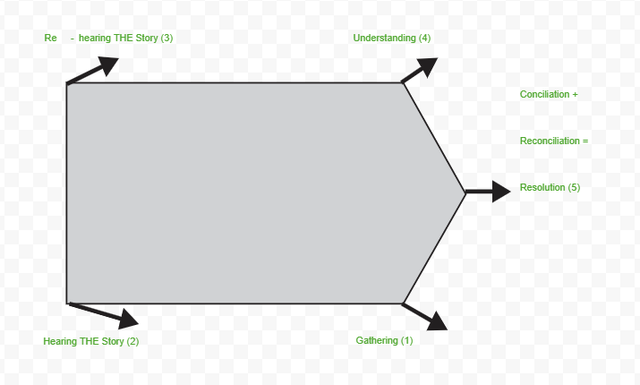
THE PENTAGON FRAMEWORK
The five cornerstones of the Pentagon Framework are the soul of mediation. When mediators get it right at this foundation level, they succeed. Whether you understand mediation as Al-Masīḥ (Anointed)/Divine Dispute Resolution (ADR); Alternative Dispute Resolution (ADR); or African Dispute Resolution (ADR), they are all the same – Amicable Dispute Resolution (ADR), at one degree or another. If you have struggled with doing good mediation or doubted the power of mediation, master the Pentagon Framework’s sequential five cornerstones and you will be transformed and convinced.
The first of the five cornerstones is GATHERING. Here the mediator gathers the parties to himself or herself, into their heart. They must do this because, as we said above, mediators must hear the parties in their hearts: the heart hears it far better than the ear does. In any event, where would you gather parties except where you truly can listen to them, which is in your heart?
Having secured the parties in your heart, you have released their tongue to talk unendingly, first the tongue of one party, which is coded as Cornerstone No. 2 and then the other party’s tongue, coded as Cornerstone No. 3. And as they talk, you harvest their unmet needs, which is Cornerstone No. 4. Once you have thus opened their eyes to their unmet needs in Cornerstone No. 4, you would see a gradual but certain rapprochement, a coming back together between them, between the parties, which would eventually lead to a rich resolution, which is cornerstone No. 5 – set offer and acceptance of conciliation and reconciliation, which graduate into the resolution they need – the end of conflict resolution at the foundational but most critical level.
- Building Effective Conflict Resolution
As you dig the foundation of conflict resolution, the materials you dig out are not wasted. They form the bricks that you use to build the house of conflict resolution, which is done in ten steps. Hence, I call it the 10-step-mediation. Let us examine them one after the other.
The first building block or step in mediation is Understanding the parties’ feelings. Parties get to third-party mediation because their relationship has failed to meet one or two parties’ needs. Unmet needs eventually create bad feelings. When parties arrive at mediation, they have hurt feelings. The conflict resolution begins there: how are the parties feeling? The mediator would not ask them the question frontally but by applying the ground rules of mediation described above, mediators can extract the feelings from the parties.
The second building block or step in mediation is dealing with the parties’ feelings. This is calming their feelings to prevent escalation and to put it under firm control as much as possible. The big question is why do we mediators pay so much attention to the feelings of parties? First, it is not to end the conflict through calming and assuring people. It is because strong emotions, be they positive or negative feelings, block clear thinking. It is only at step 10 that we can hope to resolve a conflict. Therefore, it is self-deception to assume that by calming people down, one has achieved conflict resolution.
The second building block or step in mediation is understanding the parties’ problems. Like feelings, problems are not conflict albeit indicative or syntomic of conflict. Problems are the negative steps people take when conflict is not resolved early. Fighting, wars, destruction of property, physical abuse, etc., are all problems, all symptoms of conflict. But they are not conflict. Therefore, good mediators distinguish between feelings, problems, and unmet needs – the real and only true causes of conflict. This understanding makes mediation unique and outstanding in that it can, most likely, pinpoint and diagnose the real drivers of any conflict. This understanding also saves the energy often wasted on relatively irrelevant matters. The ability to isolate and appreciate problems ensures that they are provided for and solved, which frees the mind and the time to discover, understand, and face the real drivers of conflict, which are unmet needs. The ubiquitous problem of wars, for example, calls for a cease-fire solution, just like the equally universal feeling of anger calls for calming down. In both examples of the negative emotion of anger and the problem of war, the calming down and the cease-fire enable the mediator and parties to move on to the roots of the conflict, that is, the unmet needs, which led to the negative emotions, such as anger, and problems, such as wars, in the first place. When these symptoms feelings and problems are thus isolated and addressed, the real conflict resolution can proceed with more likelihood of a resolution being found.
The fourth building block or step in mediation is understanding unmet needs. This is the heart and core of good conflict resolution that mediation epitomizes, and it makes mediation the king and queen of all conflict resolution efforts globally. We have already explained the importance of understanding unmet needs: if they are not isolated and addressed, negative feelings and problems persist, which are symptoms of the deeper malaise of unmet needs. Once the unmet need in the relationship in conflict is isolated, resolution is in sight.
The fifth building block or step in mediation is asking distinct and specific questions on how specific unmet needs may be met, one question per unmet need. If there is only one unmet need behind the conflict, one question would be asked on how it may be met. If there are more unmet needs, there would be as many questions as correspond to the number of unmet needs – one question for each unmet need. In teaching mediation, I always instruct student-mediators to write these questions on separate paper or notebooks. This is to avoid mixing up the questions. One sheet of paper or notebook per question. If it is a relatively minor conflict, use sheets of paper. If it is a major conflict, use notebooks.
The sixth building block or step in mediation is brainstorming by parties for options on how each unmet need may be met. There is no limit to the number of options that address one question on how a need may be met. The parties are responsible for floating the options, while their mediator is responsible for noting and jotting down all the options proposed for meeting each unmet need. As I mentioned, I always instruct my student-mediators to write the questions in step five above on separate sheets of paper or notebooks, to avoid mixing up the questions. In step six where the parties answer the various questions by floating options, the options addressing any specific question are noted under that question on the paper or notebook where the question had been written.
The seventh building block or step in mediation is looking at each option from the parties’ brainstorming and ensuring that any unpleasant-looking or unpleasant-sounding option is rephrased to make it palatable and attractive. This will ensure that they are not outrightly rejected for sounding off, for example, for sounding insulting. The reason for taking this esthetic step seven is to ensure that all options are on the table and considered and not merely for how they look or sound. An otherwise odd-sounding or bad-looking option may contain the solution to the unmet need in question. But if those options are not considered because they were not properly rephrased to take the sting and unpleasantness out of them, they may never be considered, which would be a great loss to the parties, leading to a failed conflict resolution. The Bible in Colossians 4:6 counsels us to sweeten our words. Words have great power and must thus be treated with unending care to ensure that only their positive power is released.
The eighth building block or step in mediation is reality testing. Some options, no matter how attractive, may not work and we would therefore need to jettison them. Only workable and realistic options are retained.
The ninth building block or step in mediation is the offer of realistic and workable options to each party in the caucus and privately. We offer them in caucus and privately to each party to ensure they deeply and fully consider it. This prevents them from rejecting an otherwise good option/true answer to their unmet needs. Deep consideration and full unrestrained evaluation without the distraction of the other party also ensure that what the party accepts meets their unmet needs. In the latter case, the mediator and the party in caucus with them can identify possible wrong prognosis. Wrong prognosis/offers might have emanated from the inappropriate diagnosis, either of the symptoms of feelings, problems, unmet needs, inadequate or insufficient questions, brainstorming, options, reality-testing, etc. In both step nine cases of appropriate or nonappropriate options, corrections can be made without anyone losing face, because the offer is made and considered in caucus/confidentially.
The above scenarios of appropriate and inappropriate offers are tagged Best Alternative to Negotiated Agreement (BATNA) and Worst Alternative to Negotiated Agreement (WATNA) respectively. If what the mediator offers is appropriate to resolve the conflict, irrespective of a party’s initial reaction to it, it is a case of BATNA. On the other hand, if the mediator’s offer is not ideal for resolving the conflict, it is a case of WATNA. The critical point to note is that mediation is the solution to conflict: it is the process owned by the parties, which produces the best for them.
The tenth and final building block and step in mediation is acceptance of the tested, realistic, and workable options. It flows naturally from the ninth step. It is here that the parties document and sign who does what, when, and what happens if it is not done. The agreement includes what happens if it is not done/carried out/executed, to ensure that the parties are prepared for the future. It is most likely that they will agree to return to mediation if they have difficulties implementing the agreement.
- The Key to Effective Conflict Resolution: Trust
Trust the core and secret of mediation. It is what makes it strong, superior, and powerful.
We all know that a judge or an arbitrator, who is a judge by another name, does not need our trust when we are parties before them. This is not the same for the mediator. Without the trust of the parties, mediators fail. Trust is needed to succeed in mediation because mediators cannot dictate to people. Only what the parties agree is law. There are no impositions.
So, the key/ultimate secret of mediation and a mediator’s success is trust. But, it does not begin with the parties’ trust in the mediator. The first level of trust is the mediators’ trust in themselves. Before any conflict resolution/mediation, mediators already have deep trust and confidence in themselves. It is that confidence that the mediator takes from one conflict resolution to another. The mediator is confident that he can do it, he can mediate successfully. This trust is born from what you are learning from me in this paper. As you read me, you are developing mediator trust in yourself: you are beginning to realize you can engage parties in any conflict, of any nature, successfully. Confidence and trust are born out of the ideas I am sharing in this paper. But that is only the first level of trust.
The second level of trust is the mediator’s trust in the parties. Here the mediator is saying that if the opportunity is presented to the parties, they can work toward resolving their conflict. Again, here, the confidence is based on the knowledge of the skills that we are sharing in this paper: if you are not a skillful mediator, you cannot have trust in the parties.
The third level of trust is the parties’ trust in their mediator. At this point, the parties are saying that, based on what they have seen as their mediator leads them in their conflict resolution, there is hope for conflict resolution. What makes them trust their mediator? Again, it is the mediator’s demonstration of knowledge and skills that I am sharing with you in this paper.
Finally, the fourth and crowning level of trust is the parties’ trust in one another. We already saw this in the fifth cornerstone of conflict resolution above. Again, what would make the parties have trust in themselves again as they did at the beginning of their relationship? It is simply again thanks to the skillfulness of the mediator.
- Conclusion
I have tried to paint a picture of what mediation looks like. I do hope you can see from my narrative how mediation is the appropriate dispute resolution of all times. Before I get your feedback, kindly recall that I referred above to some manifestations of amicable dispute resolution (ADR) AKA Mediation, namely Al-Masīḥ (Anointed)/Divine Dispute Resolution (ADR) AKA How God resolves conflict; Alternative Dispute Resolution (ADR), which is the globally emerging conflict resolution; and African Dispute Resolution (ADR) AKA ancient or traditional conflict resolution. I have closely studied and published works on all three. They have all influenced my thought and practice in conflict resolution and mediation. Whether with God, humanity, or ancient local practices, mediation is the dispute resolution of choice.
I now close this keynote presentation by humbly submitting that no other dispute resolution mechanism has the in-built power to make combatants partners and turn dissociation into the association as mediation eminently does.
I welcome your feedback.
Olajide OLAGUNJU PhD, CertMed, CertArb, FICMC, FICIArb, FCIArb, Attorney at Law
President and Professor of Conflict Resolution at Jesus College, Maryland-USA
Email: president@jesuscollege.org
Add a Comment